

INTRODUCTION
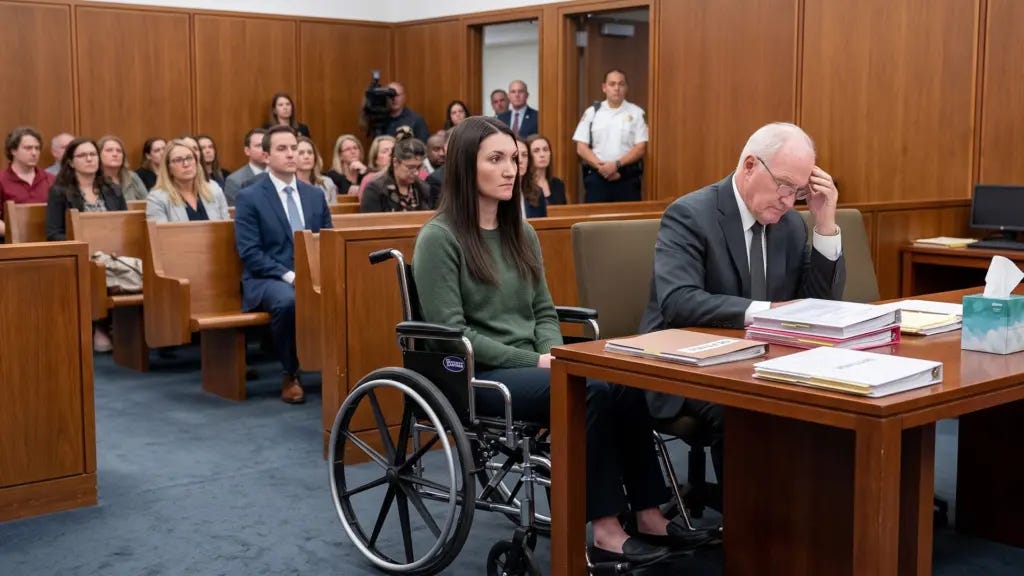
Millions of Americans and people around the world are focused on a case being tried in Plymouth, Massachusetts to a jury. The defendant, Lindsay Clancy, is charged with three (3) counts of first-degree murder. She was a labor and delivery nurse at a respected hospital, and she had no criminal past. There was no boyfriend, no desire for another life ala Susan Smith, or any other motive. What sets this case apart is the horrific reality that she is charged with the murder of her three children, aged 5, 3, and 8 months. The prosecution contends that the murders were methodical and planned. The defendant, they contend, sent her husband out to get takeout food and to fill a prescription for one of the children. During his absence, she strangled the children, one by one, which took some time, and then she tried to commit suicide by exiting the second-story window after slitting her wrists and, allegedly, her throat. She sustained injuries after landing on frozen ground, which left her partially paralyzed from fractures of her cervical and thoracic vertebrae.
The defense, in contrast, does not dispute that she killed her children but has interposed a rarely utilized defense in criminal law—the insanity defense—which sounds in a severe form of postpartum depression known as postpartum psychosis. Her counsel contends, with evidence, that up until that horrific day she was a doting and loving mother who, in the months before the January 24th, 2023, homicides, had multiple treatments for suicidal ideation as well as intrusive thoughts of harming the children. The defense has presented evidence that there were thirty (30) prescriptions for at least thirteen (13) medications which were prescribed by health care professionals who were acting in a negligent manner and exacerbating her issues by throwing pills and methods at the defendant that simply enhanced her symptoms and made them worse. She had committed herself to a mental hospital and had called suicide hotlines. These “professionals” worked at cross purposes and without a review of such medications or a coordination of treatments. The defendant’s family has confirmed her pleas for help and the many attempts at treatment.
The case has devolved into a battle of experts. The defense experts have stated that the defendant suffered a psychotic episode at the time of the killings and that she had no ability to appreciate the criminal or moral consequences of her actions. The Massachusetts law in play will be discussed in detail below. The prosecution’s witnesses have testified that there was no such episode, and no diagnosis of any psychosis is present in any record. They contend that the methodical nature of the act shows planning and awareness that is inconsistent with a lack of capacity to conform her conduct to the law.
The public is, of course, divided over such a defense in the face of dead children. The very nature and effect of an insanity defense has been long debated by courts and legislatures struggling to find a balance between the protection of society and the realization that some accused of crime have mental diseases that block the capacity to discern right from wrong. Public outrage over previous publicized cases has led to both Congress and state legislatures refining the law regarding such pleas in the face of acquittals. These initiatives have limited the scope of the defense. Most states, except Massachusetts, place the burden on the defendant to prove lack of capacity. I will discuss some history below in two cases that have shaped the modern law.
Criminal law, it has been said, is an expression of the moral sense of the community. The fact that the law has, for centuries, regarded certain wrongdoers as improper subjects for punishment is a testament to the extent to which that moral sense has developed. Thus, society has recognized over the years that none of the three asserted purposes of the criminal law—rehabilitation, deterrence, and retribution—are satisfied when the truly irresponsible, those who lack substantial capacity to control their actions, are punished in accordance with traditional criminal penalties. Those rare defendants who are found by the trier of fact to be innocent on the basis of such a defense are not subject to prison or that form of punishment but are remanded to secure facilities for long-term treatment in a lockdown environment. Many have been there for years. That is where Lindsay Clancy will go if found not guilty under the applicable Massachusetts standard for such mental disease or defect. She will more likely commit suicide wherever she is sent, and even her defense experts have stated that this is an inevitability. She will provide her own form of justice.
A BIT OF HISTORY—TWO HIGH-PROFILE DEFENDANTS IN DIFFERENT CENTURIES DID MUCH TO SHAPE MODERN LAW: DANIEL MCNAUGHTON (aka M’NAGHTEN) AND JOHN HINCKLEY
In 1843, a Scottish woodworker named Daniel McNaughton armed himself and lay in wait outside of the residence of the Tory Prime Minister Sir Robert Peel. McNaughton suffered from a mental illness that caused him to experience paranoid delusions. He thought the Catholic priests and the Tories conspired against him. His delusions caused him to believe that Tory spies were following him and had conspired to kill him. His response was to kill Sir Peel. He followed a man who he thought was Sir Peel and shot him dead. However, the man he killed was Peel’s secretary Edward Drummond. McNaughton was arrested and charged with murder. He restated his delusions to the constables, and his defense counsel entered an insanity plea. Crown experts confirmed these delusions, and even the Crown Solicitor agreed. He was acquitted and was nonetheless institutionalized for life.
The Queen of England and the public writ large were outraged at the verdict. This was a tumultuous time, and many in government and the monarchy were targeted. The Queen ordered the House of Lords to assemble prominent jurists to come up with a definitive test for insanity or mental disease that would relieve a defendant from criminal responsibility. What emerged has come to be known as the M’Naghten test:
“Every man is to be presumed to be sane, and … that to establish a defense on the ground of insanity, it must be clearly proved that, at the time of the committing of the act, the party accused was laboring under such a defect of reason, from disease of mind, and not to know the nature and quality of the act he was doing; or if he did know it, that he did not know he was doing what was wrong.”
Many states, including Virginia, use some version of this test, but the modern rule places the burden of proof of these factors on the defendant, not the prosecution. It is rarely used and is most often unsuccessful. Idaho, Montana, Utah, and Kansas do not recognize the “insanity” defense in this form but do have a procedure for finding the defendant “Guilty but Insane.” The same result obtains—institutional commitment—but the procedural use of mental incapacity is to negate the criminal intent necessary for conviction.
Fast forward 138 years or so to the case of John Hinckley. This moron was obsessed with actress Jodie Foster, who was a key part of the movie Taxi Driver, a 1976 film by Martin Scorsese set in New York City. Robert DeNiro played Travis Bickle, a Marine veteran who drives a cab and is himself obsessed with protecting Foster’s character, a child prostitute, from her pimp played by Harvey Keitel. Bickle kills the pimp and is hailed as a hero even though he also almost killed a presidential candidate but was scared off by an alert Secret Service agent. Hinckley harbored delusions that if he killed President Ronald Reagan, he would impress Foster. He positioned himself outside of the Washington Hilton Hotel in the District of Columbia on March 30th, 1981, and armed himself with a German Rohm .22 cal revolver. He inexplicably got close enough to spray the rounds in the direction of the President who was being escorted into his limousine. One of the rounds struck the President, who nearly died from a wound in the lung, and paralyzed Press Secretary James Brady, who suffered for life and died in 2014 as the result of these injuries. Hinckley was not charged even though the Medical Examiner ruled his death years later as a homicide. Rounds also struck Secret Service agent Timothy McCarthy and DC Metro police officer Thomas Delahanty. They recovered.
Hinckley’s defense pled insanity based upon these delusions, and Hinckley was acquitted. To say that the public was outraged is a vast understatement. Within a month after the verdict and while Hinckley started a thirty (30) year stint in a mental hospital, Congress passed the Insanity Defense Reform Act of 1984, which was signed into law by President Reagan himself. It changed the applicable Model Penal Code standard used in the Hinckley trial, which stated:
A person is not responsible for criminal conduct if at the time of such conduct as a result of mental disease or defect he lacks substantial capacity to appreciate the criminality (wrongfulness) of his conduct or to conform his conduct to the requirements of law.
Congress, in the Reform Act, changed the burden of proof from the prosecution to the defense and made it more difficult to prove mental disease or defect, now requiring a “serious” mental defect.
Hinckley got away with murder and criminal responsibility. He was declared competent in 2016 and in 2022 was released from all supervision. He lives in Virginia. He was not tried as the result of Brady’s death from the gunshot wounds. He plays the guitar, and nobody cares.
MASSACHUSETTS HAS RETAINED THE DEFENSE-FRIENDLY STANDARD AND PLACES THE BURDEN OF PROOF ON THE COMMONWEALTH TO NEGATE THE MENTAL DISEASE OR DEFECT DEFENSE
The highest court in Massachusetts in 1967 set forth a test that has been distilled into a jury instruction that will be given to the jury in the Clancy case. It places the highest burden of beyond a reasonable doubt on the Commonwealth to prove that Clancy’s claimed mental disease did not exist or, if it did exist at the time of the crimes, did not prevent her from conforming to the law. As late as March 2026, the Massachusetts Supreme Judicial Court approved the following Model Jury Instruction:
Criminal responsibility is a legal term. A person is not criminally responsible for his conduct if he has a mental disease or defect, and, as a result of that mental disease or defect, lacks the substantial capacity either to appreciate the criminality or wrongfulness of his conduct or to conform his conduct to the requirements of the law. If the Commonwealth has proved to you beyond a reasonable doubt that the defendant was not suffering from a mental disease or defect at the time of the killing, the Commonwealth has satisfied its burden of proving that the defendant was criminally responsible.
If the Commonwealth has not proved to you beyond a reasonable doubt that the defendant was not suffering from a mental disease or defect at the time of the killing, then you must consider whether, as a result of a mental disease or defect, the defendant lacked the substantial capacity either to appreciate the criminality or wrongfulness of his conduct or to conform his conduct to the requirements of the law. To establish that the defendant had the substantial capacity to conform his conduct to the requirements of the law, the Commonwealth must prove beyond a reasonable doubt that any mental disease or defect that may have existed did not deprive the defendant of his ability to behave as the law requires, that is, to obey the law. The word “appreciate” means to understand rather than merely to know. “Criminality” means the legal significance of conduct; “wrongfulness” means the moral significance. The Commonwealth must prove that the defendant knew and understood that his conduct was illegal or that it was wrong. It is not enough for the Commonwealth to show that the defendant merely knew or was intellectually aware that his conduct was illegal or wrong; rather, the Commonwealth must prove beyond a reasonable doubt that a mental disease or defect did not deprive the defendant of a meaningful understanding of the legal or moral significance of his conduct. The defendant must have been able to realize, in some meaningful way, that his conduct was illegal or wrong…
The battle of the experts continues with the Commonwealth rebuttal case on Monday, August 24th. Defense counsel Kevin Reddington has utilized the liberal Massachusetts standard to good effect in previous cases, and he has shown great skill in cross-examining the prosecution experts and in presenting his own expert team. I taught trial advocacy at William and Mary Law School, and I admire the zeal and skill with which he represents his client in a difficult and controversial case. I have learned from him.
CONCLUSION
If Lindsay Clancy was suicidal, as has been established, and sought to take her children into “heaven” or “with God” with her, as she has been quoted as saying, is this an act of planning and cognition, or is it part of a delusional psychotic episode that deprived an otherwise good mother of any ability to discern illegality or wrongfulness? Did she feel that if she were gone, no one else should have her children, and, if so, is this methodical thinking that was part of her suicide plan, with the children drawn into this selfish vortex? This jury has a Herculean task ahead to sift through hundreds of pages of medical records and crime scene evidence as well as to recall the testimony of nearly one hundred witnesses. Emotions are high as many women see such a crime as unthinkable even in the face of severe depression, yet many all over the country see a failure of a mental health system and her treaters as unindicted co-conspirators in this tragedy. In any event, we will again, as a society, react to such cases, and we hope that awareness and hypervigilance by families and the health care industry will allow more transparency so mothers can come forward and not be vilified or lose their children. We give mental illness and treatment short shrift, and we need to do better whatever the outcome of this horror story.