

INTRODUCTION
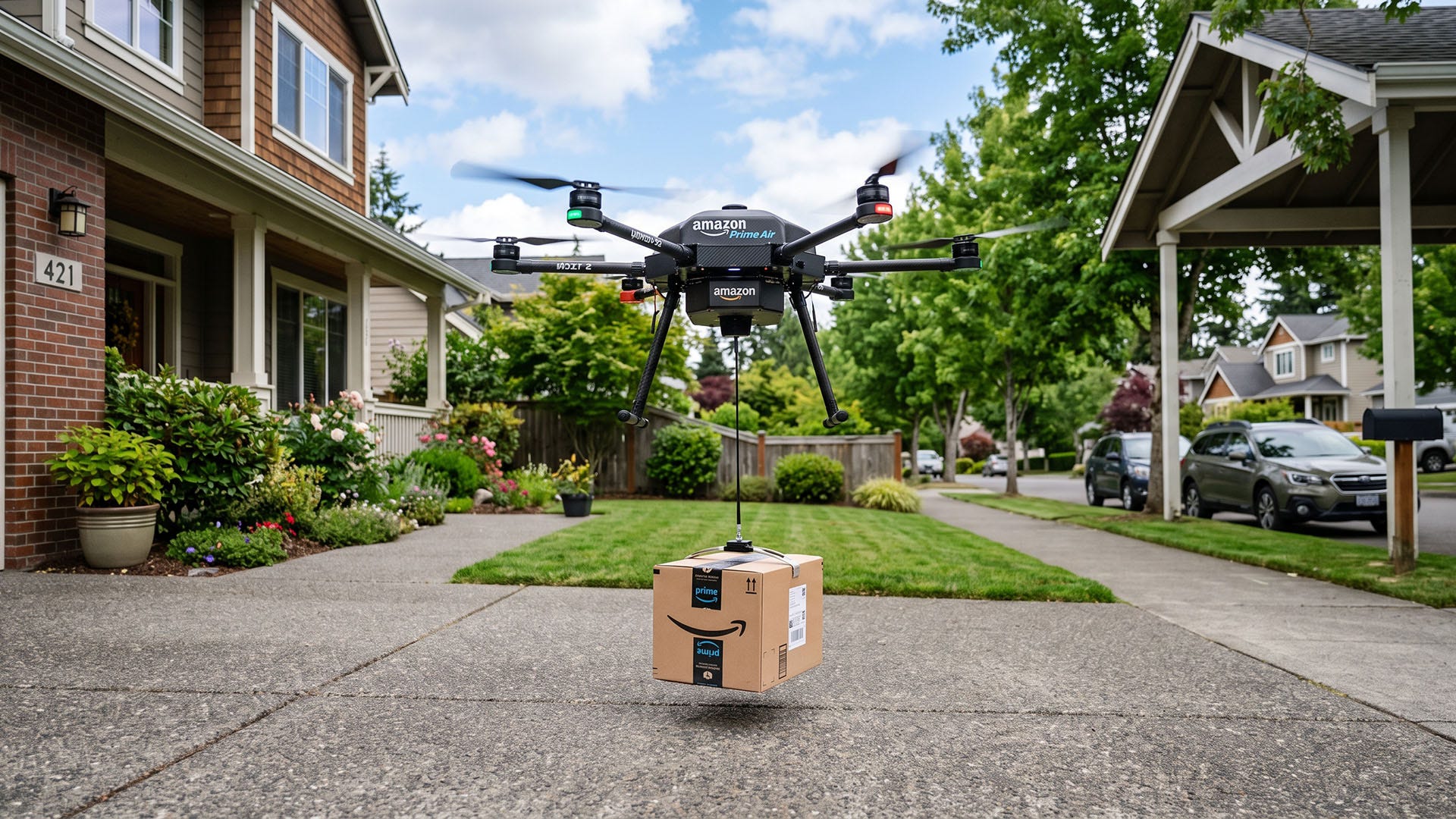
It seems that big money ensures big access. Amazon, Walmart, and other merchants are rapidly expanding their delivery options to include drone deliveries. They have a handy co-conspirator in the Federal Aviation Administration. Recent FAA regulations and federal law have the sole mission of taking and diminishing the private property rights of landowners and businesses operating in areas which will soon be saturated with overhead nuisances delivering goods by dropping them after overflying private property. Long-standing law establishes that we all have rights to airspace above our property and that a level of persistent interference with these rights that is intrusive is tantamount to taking your property for public use. The Fifth Amendment protects this use as well as state laws and constitutions. These actions can also constitute nuisances and trespasses under state law. The Federal Aviation Administration has arbitrarily determined that airspace up to 400 or more feet over your home is not really yours and has granted an unlawful easement to big retail and perhaps others to overfly your home and impair your ability to exclude them as well as your quiet enjoyment. State nuisance and trespass laws are essentially nullified if not enforced in the courts and in the public square thanks to a Tenth Amendment violating federal power grab that thumbs its nose at personal property rights so Amazon and others can save money. A pilot program in Richardson, Texas, has led to community outrage and documented incidents of intolerable noise and harassing low flights of ungainly drones that are testing existing Texas property use laws in effect decades before the “progress” of commercial drone overflights and the FAA and Amazon lovefest. Richmond is apparently in the mix as a drone hub. While we wrestle with the Fourth Amendment issues presented by saturation uses of FLOCK cameras, we now find that the Amazon drones have cameras to aid in navigation, which can see and record your backyard barbecue. If the government abets this, is that an additional unconstitutional action? This needs to be on your radar, so to speak. Yes—you own the airspace above your home, and this has been the law for decades. Is it worth forfeiting what you pay dearly for to get a delivery of trousers or underwear? No.
EIGHTY YEARS AGO, THE UNITED STATES SUPREME COURT DETERMINED THAT WE OWN SIGNIFICANT AIRSPACE ABOVE OUR PROPERTY, AND INTERFERENCE WITH THESE RIGHTS MAY BE TANTAMOUNT TO A TAKING
In United States v. Causby, 328 U.S. 256 (1946), the Supreme Court considered the case of a farmer who maintained a home and chicken ranch outside of Greensboro, North Carolina. Military aircraft training during World War II led to frequent low-level overflights that created noise and vibration such that the chickens panicked and died flying into the walls of their stalls. The farmer had to stop production and his livelihood as well, and the enjoyment of his homestead was impaired to such an extent that the Court found that his land was taken. Compensation was ordered by the Court of Claims. The Government claimed an unlimited easement over the property. The Supreme Court disagreed:
We have said that the airspace is a public highway. Yet it is obvious that if the landowner is to have full enjoyment of the land, he must have exclusive control of the immediate reaches of the enveloping atmosphere. Otherwise, buildings could not be erected, trees could not be planted, and even fences could not be run. The principle is recognized when the law gives a remedy in case overhanging structures are erected on adjoining land. The landowner owns at least as much of the space above the ground as he can occupy or use in connection with the land. The fact that he does not occupy it in a physical sense—by the erection of buildings and the like—is not material. As we have said, the flight of airplanes, which skim the surface but do not touch it, is as much an appropriation of the use of the land as a more conventional entry upon it. We would not doubt that if the United States erected an elevated railway over respondents’ land at the precise altitude where its planes now fly, there would be a partial taking, even though none of the supports of the structure rested on the land. The reason is that there would be an intrusion so immediate and direct as to subtract from the owner’s full enjoyment of the property and to limit his exploitation of it. While the owner does not in any physical manner occupy that stratum of airspace or make use of it in the conventional sense, he does use it in somewhat the same sense that space left between buildings for the purpose of light and air is used. The superadjacent airspace at this low altitude is so close to the land that continuous invasions of it affect the use of the surface of the land itself. We think that the landowner, as an incident to his ownership, has a claim to it and that invasions of it are in the same category as invasions of the surface.
States have used the Causby doctrine to balance personal property rights with the complexities of modern airspace use. It is the law that we have the rights to the immediate reaches of the enveloping atmosphere of our properties and that we have the right to exclude and the right to enjoy that space. How much of that space is open to question? There is no question, however, that state laws must be enforced and given effect to avoid the all-encompassing pre-emption and usurpation of personal property rights which the apparent FAA/Amazon/Big Retail partnership has unleashed.
VIRGINIA HAS ENACTED SUCH LAWS IN THE CRIMINAL SPHERE, BUT CIVIL ACTIONS ARE VIABLE WITH THE RIGHT FACTS AND INTRUSIONS
Virginia has criminalized certain uses of drones, or Unmanned Aerial Systems (UASs), in certain specific contexts. Although a step in the right direction, the seemingly arbitrary distance of fifty (50) feet of a home for the matter to rise to the level of a Class I misdemeanor does not send the right deterrent message. The following is a short explanation of Virginia UAS-specific laws printed at the Unmanned Safety Institute website for review by UAS operators:
Code § 18.2-121.3—Trespass with an unmanned aircraft system
This is the workhorse statute. Section 18.2-121.3 makes it a Class 1 misdemeanor to knowingly and intentionally cause a UAS to:
enter the property of another and come within 50 feet of a dwelling house to coerce, intimidate, or harass another person, or after actual notice to desist for any other reason;
take off or land in violation of FAA Special Security Instructions or UAS Security Sensitive Airspace Restrictions—the state hook the Commonwealth uses to layer prosecution on top of any FRZ or SFRA violation;
drop any item within the boundaries of, or obtain any videographic or still image of any identifiable inmate or resident at, any state or local correctional facility or juvenile correctional center.
Class 1 misdemeanor in Virginia is up to twelve months in jail and a fine up to $2,500.
The Virginia General Assembly added two new felony tiers in the 2025 session, both effective July 1, 2025 and codified at § 18.2-121.3 (2025 Acts of Assembly, cc. 374, 381, 622—HB 1726 / SB 757 / SB 1272):
Subsection B—Class 4 felony for unauthorized UAS over critical infrastructure or covered facilities. Knowingly and intentionally, without authorization, causing a UAS to enter the airspace over (i) public services or utilities described in § 18.2-162, (ii) critical infrastructure as defined in 42 U.S.C. § 5195c—including any military base authorized by the U.S. Department of Defense—or (iii) any facility covered by the Maritime Transportation Security Act (46 U.S.C. § 70101). Subsection C carves out consent, federally authorized operators flying lawfully, on-duty employees, and utility / critical-infrastructure / MTSA-facility employees on official business.
Subsection D—Class 4 felony for contracted-defense-facility imagery. Knowingly, intentionally, and without authorization causing a UAS to enter the property of a contracted defense facility and obtaining or attempting to obtain videographic or still imagery containing controlled technical information (DFARS clause 252.204-7012). Operators and employees of contracted defense facilities receive criminal-prosecution and civil-liability immunity for non-injurious counter-UAS action.
Class 4 felony in Virginia is two to ten years in prison and a fine up to $100,000. The change traces back to the cluster of unidentified drone sightings over Joint Base Langley-Eustis across 17 nights in December 2023, which the Pentagon publicly confirmed and which prompted broader review of Virginia’s federal-facility protections.
Va. Code § 18.2-130.1—Peeping by drone
Section 18.2-130.1 was amended in 2023 to explicitly name unmanned aircraft systems. It is a Class 1 misdemeanor to knowingly and intentionally cause a UAS to secretly or furtively peep or spy, or attempt to peep or spy, into or through a window, door, or other aperture of any building occupied or intended for occupancy as a dwelling, where the conduct would violate the occupant’s reasonable expectation of privacy. The traditional Peeping Tom statute at § 18.2-130 still applies independently.
There is a carve-out for lawful criminal investigations. Practical effect: drone operators who film into fenced backyards, bedroom windows, or hotel-room balconies face the same exposure as a person with a long-lens camera on foot.
VIRGINIA’S PUBLIC POLICY FAVORS THE USE AND ENJOYMENT OF PROPERTY AND HAS LONG-STANDING NUISANCE AND TRESPASS JURISPRUDENCE
The Virginia Supreme Court has distilled, in a long line of cases, distinct doctrines of nuisance and trespass, which may provide a remedy to a landowner who has experienced an intrusion by drone and perhaps a pattern of overflights that present a nuisance and/or a trespass.
TRESPASS
“A trespass is an unauthorized entry onto property which results in interference with the property owner’s possessory interest therein.” 5 Richard R. Powell, The Law of Real Property ¶ 707 (Patrick J. Rohan ed., 1994). Thus, in order to maintain a cause of action for trespass to land, the plaintiff must have had possession of the land, either actual or constructive, at the time the trespass was committed. Blackford v. Rogers, 2 Va.Dec. 292, 294, 23 S.E. 896, 897 (1896).
In addition, to recover for trespass to land, a plaintiff must prove an invasion that interfered with the right of exclusive possession of the land, and that was a direct result of some act committed by the defendant. Any physical entry upon the surface of the land constitutes such an invasion, whether the entry is “a walking upon it, flooding it with water, casting objects upon it, or otherwise.” W. Page Keeton et al., Prosser and Keeton on the Law of Torts § 13, at 70 (5th ed. 1984).
NUISANCE
When a business enterprise, even though lawful, becomes obnoxious to occupants of neighboring dwellings and renders enjoyment of the structures uncomfortable by virtue of, for example, smoke, cinders, dust, noise, offensive odors, or noxious gases, the operation of such business is a nuisance. The term `nuisance’ includes `everything that endangers life or health or obstructs the reasonable and comfortable use of property.’.
The phrase `use and enjoyment of land’ is broad. It comprehends the pleasure, comfort and enjoyment that a person normally derives from the occupancy of land. Freedom from discomfort and annoyance while using land, which inevitably involves an element of personal tastes and sensibilities, is often as important to a person as freedom from physical interruption with use of the land itself. The discomfort and annoyance must, however, be significant and of a kind that would be suffered by a normal person in the community.
It would be of no defense for Amazon to state that it had a lawful permit to engage in the activity if such activity in fact became obnoxious regarding noise or simply repeated flights over your home at times that created interferences and distractions. We still have not had full disclosure on what types of on-board cameras record the path of the drone and any intrusions into protected places over which there is an expectation of privacy. The drone operator sees all in the path of the drone. These are not government actors but have been enabled by government action. These issues are ripe for testing and challenge, as it appears Amazon has a green light to unleash this menace on all of us. Wal-Mart, DoorDash, and others will follow suit and turn our tranquil spaces into a new and obnoxious form of commerce.
CONCLUSION
The power of the Big Retail lobby has led to FAA complicity in the diminution of your personal property rights. Whether a pattern of intrusions and overflights are tantamount to a taking, a nuisance, or a trespass under state common law is very fact-specific. We must ask the same questions of these commercial drone operators that we ask of data center operators and FLOCK camera providers and users. Engagement in local and state lawmaking and public hearings is a must. You need to know these things. Not all so-called advancements are progress.
Mike Imprevento
September 28th, 2026